Thursday, 23 April 2015

Inquiry - Earth and Space Systems

As I kicked off the Earth and Space Systems strand of my grade 7/8 Science programme, I wondered what sort of authentic task I could ask students to create in order for them to show me their learning. I have a Grade 8 class who in general are very creative and hardworking, but love their text book work and are very reluctant to accept any summative task that is not a test. I have a grade 7/8 class, who need a lot of structure, class time and encouragement in order to produce. Lastly, my grade 7 homeroom, loves to jump on inquiry tasks, but loses track of the big ideas and the curriculum along the way.

My answer: Bill Nye inspired Science videos.

The ironic part was that, while the Grade 8s were open to learning the facts and text books work, the unit content was not as heavy as the Grade 7 curriculum. I was able to get them started on their script writing right away. Some groups finished their script in the same work period! I decided to duplicate the same process that I use with my homeroom class, write the script, upload to D2L, give them feedback, and submit final copy. Some began by filming their footage (demos, lego stop motion) while others needed to practice their script or experiment with the app or program they decided on. They are very task oriented and were focussed on the due date and getting it done. I have no doubts this group will be the first to finish.

The grade 7s on the other hand, were thrilled to have the opportunity to "film at the creek" or try out white board explain everything type of programs such as powtoons I had to keep refocussing on the Science content, and in the meantime, I'm still teaching them procedure writing, proper lab execution as well as observations (I have given the option to do video observations) and conclusions. I'm hoping they will use some of their footage from their labs for their Science videos.

I did end up creating a rubric as well as a reflection task sheet that they had to follow in order to get their video done.

It would've been much easier for me to give them a study guide and a test. Committing to inquiry is more work for the teacher. You need to accept that some groups need more time and others need to be encouraged to experiment, push themselves and try things they didn't think they could, or maybe were not in their original plans.

Even though this is guided inquiry, the conversations most groups are having around what the message of their video will be, has been very rewarding. The written output may not necessarily show how much they know. I really need to make an effort to be near a group while they are discussing. The process is now become more important than the product, which is what I want my students to understand and enjoy before they leave my classroom.

I recently had a discussion with the grade 8s encouraging them to ask teachers to give them options next year. I can't guarantee that their grade 9 teacher will, but at least they can advocate for themselves feeling confident that they were able to show their learning not just with paper and pencil tasks.

On Earth Day, I proudly sent pair of Grade 8s to showcase all the videos to all the other classes in our school. Meanwhile, I'm patiently waiting for some Grade 7s to hand them in.

Without further ado...here are some of our videos! (There are more still coming, I will make them public on our Youtube channel.)

Monday, 13 April 2015

Enthusiasm over Lit Circles

Gone are the days of the whole class novel study. My class read aloud takes all year, which I'm ok with as we are reading Wonder and I know the themes will be important for as long as we can read it together if not longer.

The first round of lit circles, we focussed on making connections. My diagnostic reading assessment showed students had a lack of higher order thinking skills when reading, especially when it came to making connections. In the end I taught the double entry journal. They had to make 4-6 connections per session, plus have a discussion and record themselves during every meeting.

The second round of lit circles my theme was historical fiction. They were to be working on writing with their history teacher and I thought it may help them to read fiction in a historical setting. They again had to have meetings but were to answer questions to help their discussion for every session.

The third round the theme is now "coming of age." I was inspired by this unit I found on Teachers Pay Teachers. I've never used this theme before, but figured it would be a challenge for them to justify that their choice of novel fits into the theme, what better way to focus on inferencing. Right now we have Matched, The Uglies, Divergent, Camp 30 (a sequel to Camp X that the group decided to read together) with a few other students still deciding. I wasn't sure if the challenge was going to be finding a group or a novel, but they have really impressed me so far!!

For a response, I will have them work for a period on making their own questions for the session using reciprocal teaching or any other questions that have been used this year. I will also add some poems that I hope fit into the theme so I can sit with small groups as we work on inferencing responses.

I'm really looking forward to this lit circle!

Sunday, 1 February 2015

Success with Reluctant Writers

Finally!

As I'm sitting here finishing up my reports cards and marking narratives/retells that took us forever to write, I'm quite pleased with everyone's progress. This is a class who in general, when I had them write their first OWA in September, sat for 20 minutes staring at their paper, not knowing what to write. After 40 minutes, I was lucky to get a paragraph from the majority. Their EQAO results from last year were even more dismal, what was I to do?

Luckily, I work with some wonderful teaching colleagues in my division. Mrs. C. was inspired over the summer while listening to The Vinyl Cafe , wouldn't it be fun if we listened to some podcasts, then the students would write their own stories, and create their own podcast? So began my journey of turning paragraphs into full out podcast quality stories.

We listened to one story a week for six weeks. Our week is divided into four hour long language periods. One was for a writing mini lesson, the other for reading, and two story listening days consisted of a listening then a discussion period where we took up the questions. They also had vocabulary that they had to look up before the listening session. The students were loving the stories, it was going very well!

Then it came time to write our stories...

We began by using the Writer's Notebook for ideas. We created lists upon lists of ideas that would be interesting for listeners. We ended with a list of "Funny things that happened to me that I could write about." Here's where I decided to let them write recounts if they chose. I began writing my own recount, they even chose the topic for me: my daughters.

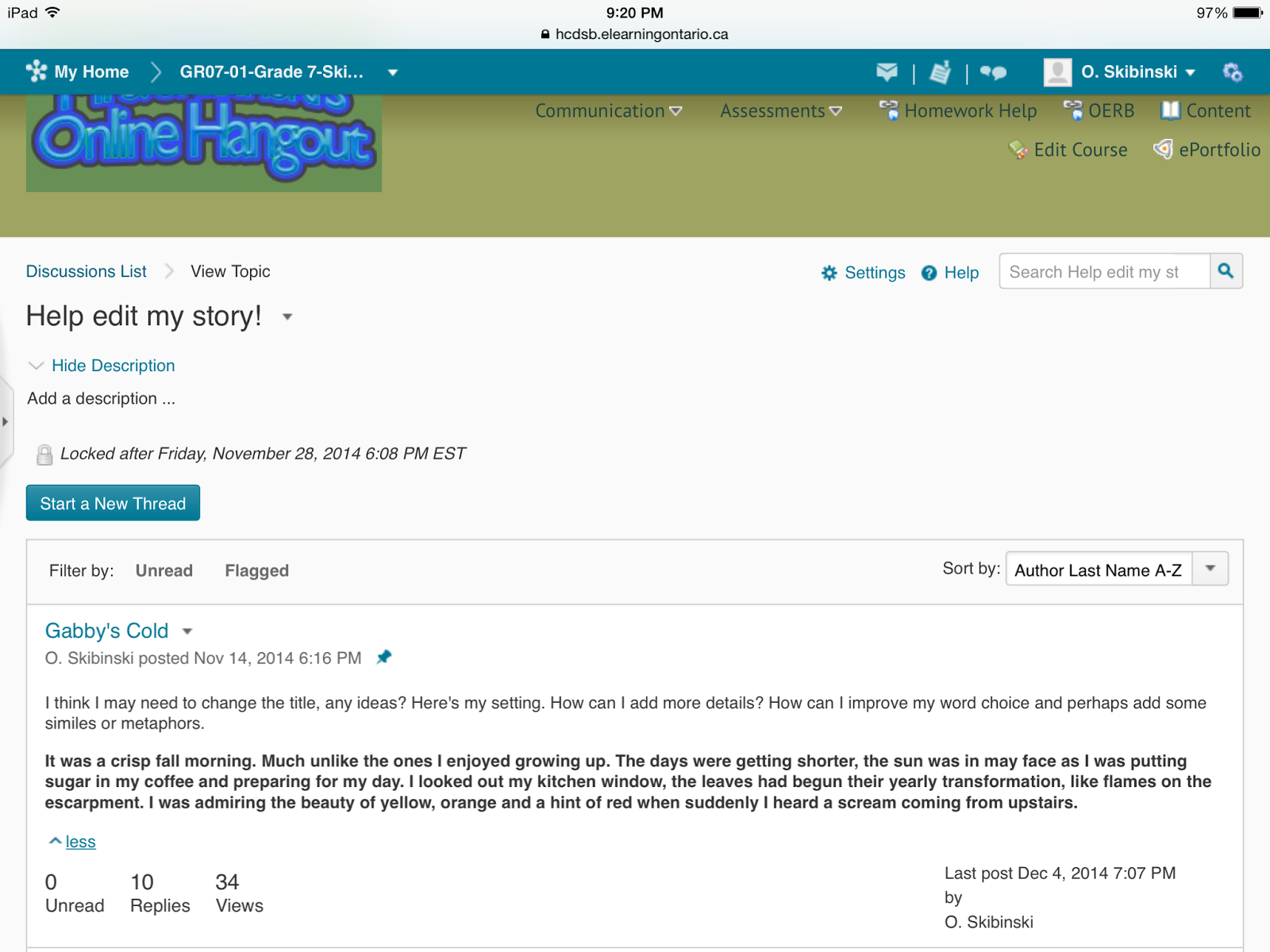
I wanted to show them that writing a good story takes time. I started with the first paragraph of my story and posted it on a D2L discussion forum. I then asked for feedback, at this point my story was only a descriptive paragraph of the setting. After their feedback, I posted a rough draft of my story and shared it with them using Google Docs. The title was a work in progress, everything was. Instantly, my confident writer's began to give me feedback. My story continued to grow, just as they were planning the writing for their own stories.


Eventually, they started submitting rough drafts to our D2L dropbox. I didn't focus on conventions at all, just organization, and form. They would read my feedback, and resubmit a new copy, received more feedback and the cycle continued. Most students submitted at least two drafts, and every single one of them used the feedback to make their story better.


Now around Christmas time (you know that time of year where interruptions seem endless and preparations for the concert take over instructional time), Mrs. C and Mrs. G. had their students submit good copies of their narratives for marking. I knew my class was not ready. So we printed out our final draft and I brought in all the mini lessons on anchor charts we had covered over the last few months. They were to  self-assess and improve on their writing. Mark it all up! I would be assessing how well they are able to apply good writing traits to their own writing. Then we went off for Christmas vacation.


When we came back in January, they took these drafts and perfected their final copy. They also made sure they used the feed back (dated and posted) I had given them on D2L. They submitted it to the drop box. Here I decided to print them off and post my feedback directly on this final copy. I created a check list with our learning around writing, and the feedback became my check list as well.


This was the only piece of writing I marked all term - or really, the one that I assigned a grade to. I can honestly say 100% of my students improved at least one whole level. Their drafts drove my mini lessons throughout the term and I knew they had applied that knowledge.

If I had rushed them, or given them marks instead of feedback I'm sure it wouldn't have made them better writers. Now I have a roomful of grade 7s who are excited to be writing their speeches. Every single one.